How to set up a cat play circuit without buying furniture
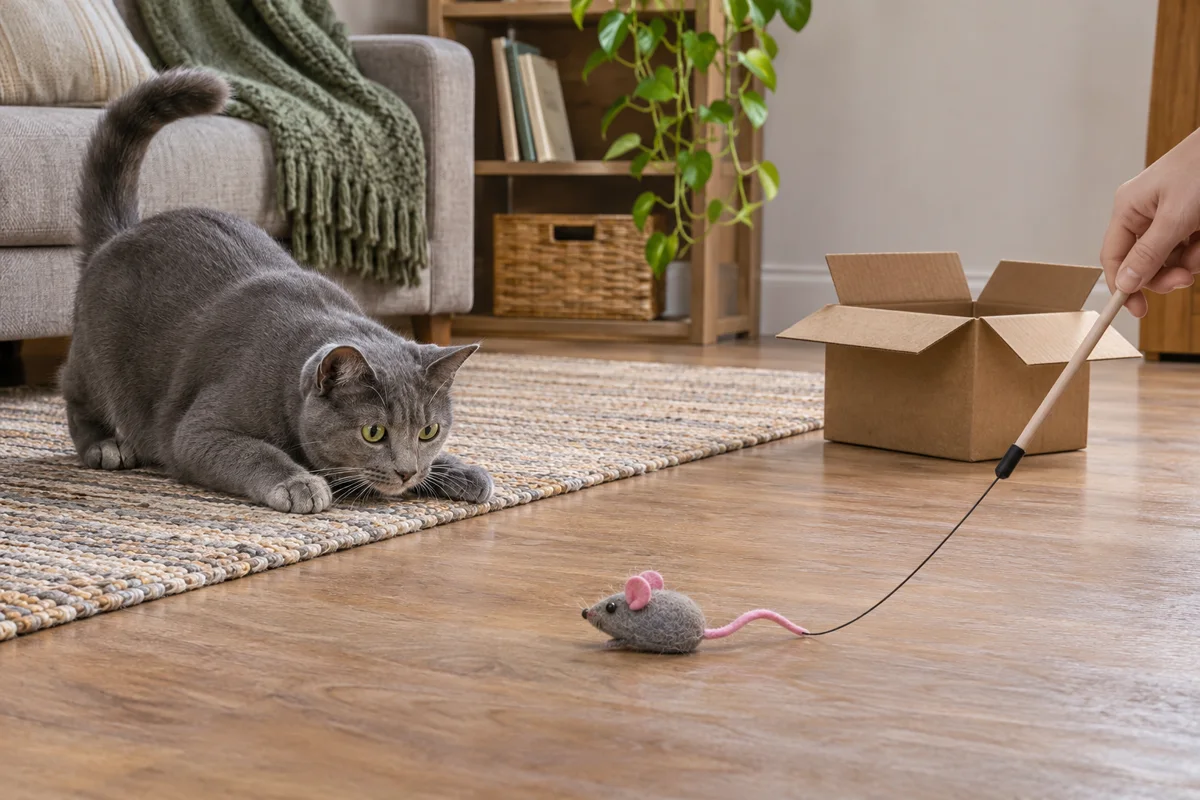
Use a clear stretch of floor, one place to pause and one toy your cat already likes. Start with a toy in view, move it slowly along the floor past a stable object, and let the cat catch it before the end of the route. The circuit can fit in one room. The cat can join for one part, watch from a hiding place or walk away without having to pass through a narrow opening.
The route works best when it follows places the cat already visits. A strip beside a sofa makes a better starting point if the cat normally walks there than a new obstacle course in the middle of a busy room. Think of it as a short route you can use for play, with clear exits and places to pause. You can set it up, use it and clear it without adding permanent fixtures.
See the three parts of a play circuit
Video summary: Clear a flat route, pause midway and end with a catch.
Choose the pieces based on your space
| What you have | How to use it | What to check |
|---|---|---|
| Clear rug or mat | Give the cat steady footing for a short approach | It lies flat when you slide a foot gently over it |
| Open cardboard box | Offer a place to watch from the side | Remove tape, staples and loose flaps, and keep the opening clear |
| Sofa arm or stable chair | Provide a visual corner the toy can pass | Leave a wide route around it and keep gaps under furniture out of the game |
| Familiar wand toy | Move it away from the cat and let them catch it | Inspect the line and attachments, and put it away after play |
| Existing floor scratcher | Add a familiar stop beside the route | Keep the scratcher stable and leave space to walk away |
1. Find the part of the room the cat already uses
Watch one ordinary evening. Look for where your cat walks after waking up and where they stop to watch you. Then trace a route between two of those places that does not lead straight to a door, a stair or a gap you cannot see into. A short route can begin on a rug, cross an open strip of floor and finish in the open beside the sofa. Leave the cat's usual resting spot available throughout the game.
Clear things that could fall or snag. Move cord loops, bags, glass objects and anything the cat might knock down while turning. Try the route yourself at floor level by moving the toy along it before the cat joins you. If the toy disappears underneath the sofa or you have to pull it back toward a table leg, choose a route that stays visible. The aim is for the cat to have a clear path to an object you can retrieve easily.
If you live in a studio, lay out the circuit when the room is quiet and put it away before you need the space again. In a household with more than one cat, you may have better luck giving each cat a short turn in a familiar space. Leave other animals where they can rest without crowding the route. A quiet game is easier to manage than one that ends with two cats trying to catch the same toy in a corner.
2. Build a beginning, a pause and a catch
Use a start point that the cat can see without leaving cover. Set the toy at the edge of the mat, move it away slowly, and pause. The pause gives the cat time to look or approach. If they are still watching, move it another short distance toward the open part of the room. Keep the toy where you can see the cat's paws and where the cat can back off easily.
For the middle of the route, use a stable object as a visual edge. A cardboard box can stand to one side of the route with its opening facing the room. The cat can watch from the doorway of the box or bypass it. Position it so it cannot slide into the path. If the cat wants to sit inside the box instead of following the toy, move the toy along the open floor and let the cat choose whether to come out.
End with a catch on a flat area. Let the cat get the toy after a short pursuit, then hold it still. Watch whether they want another pass or walk away. If you already use a particular toy for supervised play, keep the rules you normally follow, including storing string and wand toys out of reach afterward. If a toy shows exposed stuffing or loose pieces, remove it from the game.
3. Change just one part when the route gets easy
If the cat repeats the route and seems interested, move the start a little or introduce one extra pause. Change the speed only where the cat still has room to move comfortably. Avoid encouraging jumps over objects or sharp corners on a slick surface. A slower game that lets the cat see and reach the toy is easier to adjust than a fast game where the toy keeps disappearing behind furniture.
When the cat seems hesitant, shorten the route. Start with the toy already visible near the resting place and move it once. A small response can tell you whether they are curious. Let the cat pause if they want. You can finish the session after a successful catch or put everything away if they settle down. If new visitors or construction noise has changed the room, wait for a calmer time before trying again.
A scratcher can stay near the route if it's steady and already useful there. Make sure you don't put it where the cat has to walk through the activity to use it. The guide to scratcher placement shows how to match the position and angle to places the cat already uses. A familiar piece often works better at the edge of the route than a new item placed right in front of the cat.
4. Clear the circuit and note what worked
Put away the toy and clear any object that narrows a route people use. Check that the cat can reach water, the litter tray and their preferred resting place without passing through the game area. If you used an open box the cat likes, leave it only if it is clean, stable and safe to keep there. Set aside worn pieces that need replacing before the next session.
Keep a simple note for the next time. For example, you might write that the cat watched from inside the box, followed the toy along the rug and stopped after two catches. That tells you which part to keep and where to end. If you're helping a new cat settle in, start with a short game in their quiet first room and save a new route for when the cat is comfortable moving between rooms.
Frequently asked questions
Do I need a tunnel or a cat tree?
A stretch of floor, a clear resting spot and a familiar toy are enough. Use an open box only if the cat is interested and it stays safely out of the way. Add a fixture later if it solves a specific need you have seen.
How do I play in a narrow room?
Run the toy along the longest clear strip. Sit at one end and let the cat approach from the side if there's room. Keep the route away from unsecured doors and give the cat space to turn without hitting furniture.
What if my cat watches but won't chase?
Let them watch. Move the toy once across open floor and pause where it's visible. If the cat stays settled, put the toy away and try again another time. Watching from a comfortable spot is a reasonable response to a new setup.