How to compare cat carrier openings and cleaning access
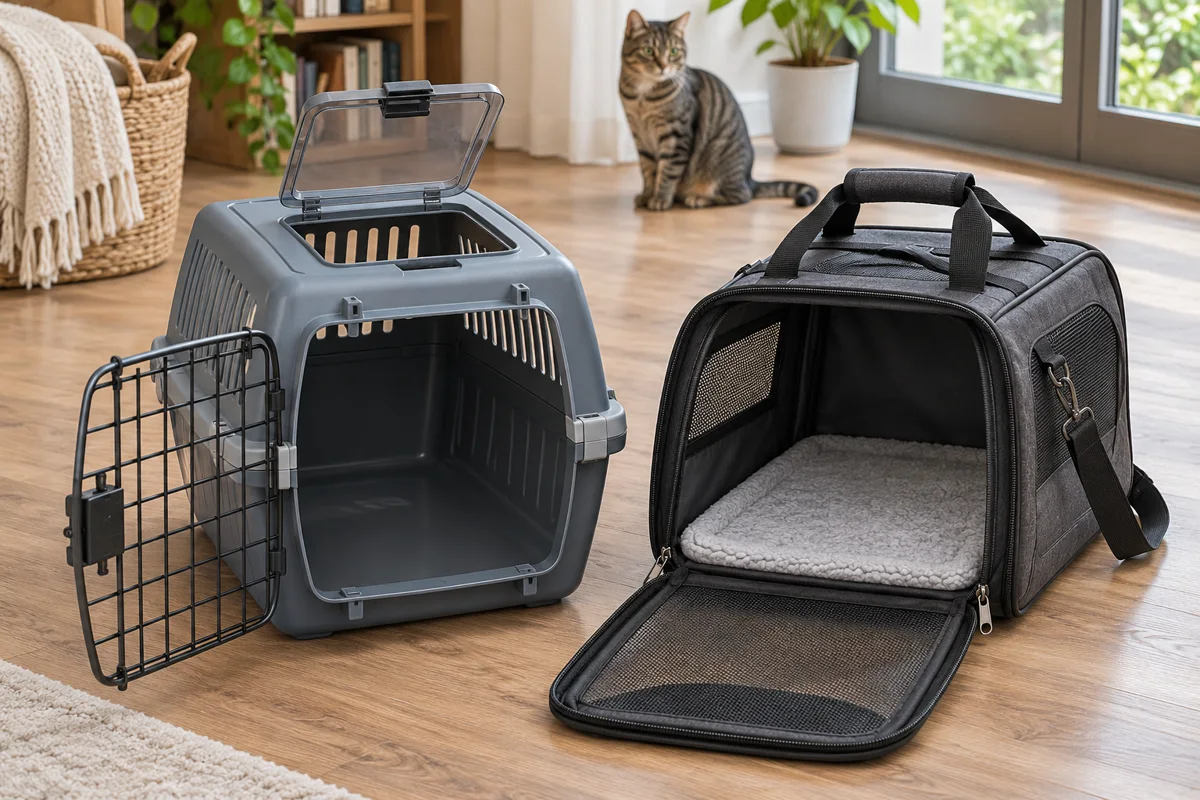
Choose a carrier your cat can stand up and turn around in, with an opening you can operate while the carrier sits flat on the floor. Check how the door latches and whether you can reach the inside corners for cleaning. A wide front opening can work well for a cat that walks in on their own. A top opening or removable upper shell can give you another way to reach the interior, depending on the design and your cat's needs.
Start with your usual trip. Carrying a cat down two flights of stairs presents different problems from walking a few steps to the driveway. Test the empty carrier through your actual doorway, beside the car and on the surface where you would clean it. If you need to tilt it to get to a latch or hold it against your body just to control the door, look for a more manageable design.
See the three carrier checks
Video summary: Measure the inside, check the latches, and make sure you can clean and dry the base.
Compare the openings directly
| Design | Where it may help | What to test |
|---|---|---|
| Front door on a rigid shell | Familiar floor-level entry and straightforward checking of the latch | Space for the door to swing fully clear and secure closure at every contact point |
| Front and top openings | Allows a second access point in a room with limited front clearance | Whether the top fasteners close securely and the opening is large enough to be useful |
| Removable upper shell | Better access to the bottom tray when cleaning | All clips or fasteners reattach and the handle is used as the manufacturer directs |
| Zipped soft carrier | A lighter option for certain trips, if allowed by the operator | Zipper closure, stable base, intact mesh and how the lining dries |
Check dimensions and restrictions from the relevant travel provider before buying for a specific trip. The same carrier does not necessarily meet the requirements for the train, an airline or a local taxi company. If the carrier will be used for a veterinary visit, you can ask the clinic whether they prefer a particular way to access the cat, especially if previous handling has been difficult.
1. Measure the opening and the usable interior
Measure the floor inside, including the narrowest point near the door. Product measurements from the outside may include feet, handles or rounded edges that don't add usable room. Check the interior height and the clearance through each opening. A carrier can have enough space once the cat is inside and still have a doorway that is awkward to enter.
Compare the carrier with how your cat stands and turns at home. If you are measuring around a cat that doesn't want to stay still, take the dimensions from a normal relaxed stance rather than trying to hold them in a particular position. Check the maker's recommended weight range as well. Weight alone won't tell you if the cat has enough floor space or whether the handle is comfortable for you to use.
Add the thickness of the pad or towel you plan to use. It should lie flat and leave the door and ventilation clear. In a soft model, check that the base supports the floor as intended. Setting a folded blanket on a sagging bottom won't tell you whether the carrier stays level when you lift it. Use only inserts and extras that work with the design and any specific transport requirements.
2. Rehearse opening and carrying while it is empty
Set the carrier on the floor and practice opening and closing it from the side. The door should be easy to control without moving the whole carrier. Check that the latch engages fully and that a grill or zipper can't be pushed open from inside when secured. If a door jams in some positions, work out whether the shell has been assembled incorrectly or a part is damaged before using it.
Try the same sequence at the height and location where you might use it. For a front-opening model, leave enough room for the door to swing and for the cat to take a step out. For a top door, make sure there is clear space above before lifting it open. A top opening on paper offers little benefit if you usually set the carrier under a shelf or in a cramped hallway.
Lift the carrier the way the instructions specify and walk through your exit. If a removable upper shell forms part of the handle assembly, check each fastening point before lifting. Inspect the grip and test whether you can set the carrier down steadily without knocking it against a step or a doorframe. On travel day, close every access point before moving the carrier and use the recommended restraint or placement for the trip.
3. See how long it takes to clean and dry
Take out the liner and check where hair and grit collect. On a rigid carrier, look inside the corners, under the lip and around the latch. If the upper shell is made to detach, practice removing and refitting it while the carrier is empty. Put fasteners in one spot so none get lost while you wipe the tray. Recheck the complete assembly before you store it or carry the cat.
Read the care instructions for both the carrier and the textile parts. A tray that can be wiped down easily may come with a pad or foam insert that needs a different cleaning method. In a soft carrier, check whether the bottom insert is removable and whether you can dry the fabric around the zipper and seams. Follow label directions for any cleaning product and wait until all parts are dry before closing the carrier for storage.
Look at the entry threshold. If you can't reach the inside with an ordinary cloth once the carrier is in its normal position, consider whether it will be practical to clean after a trip. Pick a dry storage spot where you can see if the carrier has collected dust or the latch needs attention. Store it assembled if that's what makes it easiest to check and use safely.
4. Let the carrier become part of the room
Put the open carrier on stable ground in a calm place, with the door secured open so it cannot swing toward the cat. Give the cat time to look, sniff or walk past. If they choose to sit inside, leave them space to come back out. The quiet first room guide explains how to give a new cat an unobstructed route from a carrier to a hiding place.
If the cat avoids the carrier, reconsider where you placed it. A doorway that looks out onto a busy hall can make investigation harder. Try a calmer spot and leave the carrier where it can be approached and left freely. If a necessary trip is approaching and previous attempts have been difficult, ask the clinic about a handling plan before the day of the appointment.
Frequently asked questions
Is a top-opening carrier always better?
It helps in some rooms and gives the clinic a second means of access, but inspect the opening and latches before deciding. A cat who walks into a front opening readily may do well with the simpler design.
Can I separate a removable-top carrier with the cat inside?
Ask your clinic when this is appropriate and follow the carrier instructions. A busy public space is a poor place to take a carrier apart. Practice the hardware while it is empty so you know how to secure all the fasteners before lifting.
What should make me replace a carrier?
Stop using one with a cracked load-bearing part, broken latch, torn mesh or zipper that no longer stays closed. Check whether the manufacturer offers an approved replacement part. Rehearse opening and lifting again before you rely on the repaired or replacement carrier.