How long should a dog leash be for sidewalks and open spaces?
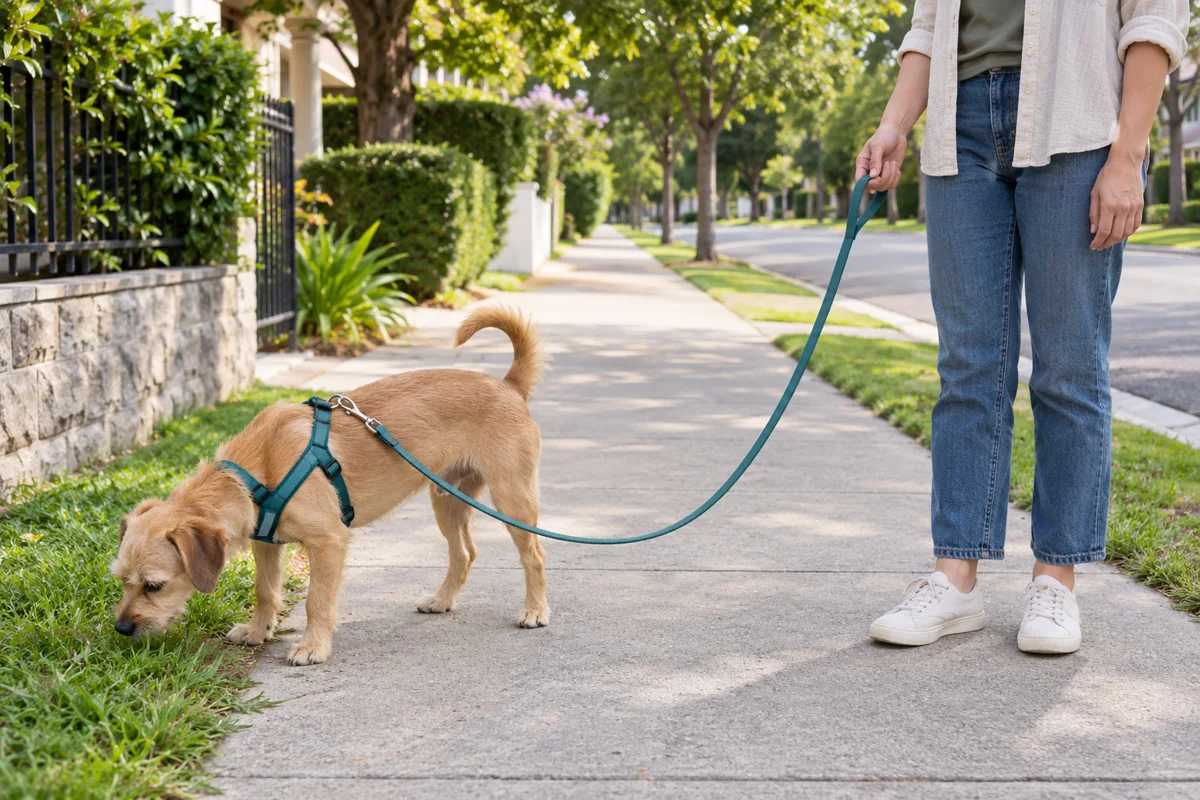
For a neighborhood walk, start with a fixed leash that lets your dog move without pulling the line tight and still gives you room to pass people and stay clear of the road. A four- to six-foot fixed leash is a common starting point. On a narrow sidewalk, use less of that length. A long line makes more sense in a quiet, open place where local rules permit it and where the full line can stay clear of other people.
If your regular loop runs from a busy front door to an open field, bring the everyday leash and change to the long line once you reach the field. Put the everyday leash back on before you rejoin the path. Those two transitions are worth planning. They keep you from having to sort loose line while a cyclist waits behind you or a neighbor is trying to get through the gate.
See where to switch leashes
Video summary: Use a fixed leash on the sidewalk. Switch to a longer line only on permitted open ground. Switch back before the path narrows.
Compare leash options by location
| Option | Where it works | What to watch for |
|---|---|---|
| Short fixed leash | Brief crossings and narrow entrances | Enough length for the dog to move comfortably by your side |
| Standard fixed leash, roughly four to six feet | Sidewalks and everyday neighborhood walks | Slack that you can gather before someone passes |
| Longer training line | Open ground with clear sight lines where rules allow it | Loose line near feet, bikes, fences or other dogs |
These are shopping categories. Decide how much length you can use at any moment based on the weather, visibility, the space you have and the way your dog is moving. If the patch of grass by the sidewalk gets narrower farther along, there is no reason to let the entire leash out just because it is already in your hand.
1. Start with the tightest point on your route
Imagine the first three minutes of your everyday walk. You might go down a short flight of stairs, step around a parked van and wait at a curb. Which of those places gives you and your dog the least room? That's where you will notice whether your setup works. Your dog should have room to make a normal step without being able to reach the street before you can respond.
Next, picture the place where you usually let your dog linger. Perhaps there's a tree on a strip of grass between the sidewalk and a cycle lane. The grass looks roomy from one side. Look again from where you would actually stand. If the line would lie across the cycle lane when your dog moves around the trunk, pick a different spot or use less leash. Look for room for the dog, for yourself and for the space between you.
When you get back, write down two moments when your current leash got in the way. Be specific. Did you have to pick up three loose loops in a hurry when someone came around the corner? Did your dog need more room to turn while you waited at a wide verge? Those are different problems. The first may call for less loose line. The second may be solved by moving where you stand.
2. Practice gathering slack at home
Hold the leash as you normally would. Try to gather a little slack while looking ahead, then release it smoothly. Keep the line clear of fingers and wrists, and avoid winding it around your hand. Check the clip and stitching, especially where the clip joins the leash. The clip should close cleanly and fit the attachment point. Large hardware can be awkward for a small dog. A skinny line can also be unpleasant to handle if it pulls through your hand.
If your dog wears a harness, check the manufacturer's instructions for its intended attachment point. The Bigodig harness fit guide explains how to take measurements and check the fit again after a walk. For long-line sessions, use a suitable harness and avoid letting a dog run until the line snaps tight. Manage the distance while there's still room to do so. If you cannot gather the line smoothly at home, try a more manageable length before taking it to a public space.
Think about everything else you carry. A leash that feels easy while you stand still in a store may feel different when you have treats, waste bags and keys to manage. Practice reaching for a bag with one hand while keeping the line clear with the other. If this exercise is frustrating indoors, it's worth simplifying before you test it next to a road.
3. Rehearse the move from open space to a narrow path
Choose a familiar sidewalk at a quiet time. As you approach a driveway, gather the slack before you reach the curb cut. Give your dog room again once you've cleared it and checked the space ahead. If a wall or a parked car blocks your view, keep your dog alongside you until you can see around it. Practice a calm move to the side while there's no one waiting for you to move.
When you have clear sight lines and permission to use a longer line, begin with a small amount out. Watch what happens when your dog turns back toward you. The line should stay clear of your feet, other dogs and anyone on a bike. If it catches on grass or threads behind you, reduce the amount you're using before you try again. Bring your dog with you as you change direction and pay attention to how the spare line moves.
At the end of the visit, switch back while you still have an open patch around you. Avoid doing the switch right at a gate where other people may need to pass close by. If your route offers few places to wait off the path, the quiet dog walk guide can help you find alternatives. A walk with several good places to turn back gives you more choices than a route with one long stretch between walls.
4. Decide what to use on the next walk
At home, ask whether you could look ahead without devoting all your attention to the leash. If you had to keep untangling loops, save the longer line for a different outing. If you changed your grip at every corner because the handle was awkward, make that feature a priority when choosing a replacement.
After a muddy walk, follow the maker's care instructions and let the leash dry before you put it away. Check the clip for grit and see whether the stitching has frayed. A washable gear station gives the everyday leash a predictable place by the door. If two people walk the dog, leave a short note about which route has enough space for the longer line and where you switch back. That helps the next person repeat what worked.
Frequently asked questions
Can I use a long line on a narrow trail?
Check the posted rules first. Even if a long line is allowed, a blind bend or trail used by cyclists leaves little room to manage slack. Use a short enough leash to keep your dog and the line out of the way, and save longer-line work for an open spot where you can see people approaching.
Will a shorter leash teach my dog to stop pulling?
Choose a length you can safely manage in the space. Teaching your dog to walk with slack takes practice in a setting where the dog can still pay attention. If you are struggling to handle the dog safely, ask a reward-based trainer for help finding a workable route and practicing the change of pace.
Should I buy two leashes?
One is enough when your regular outings all have the same needs. Consider a second line if you often visit open land where you can use it safely and legally. Keep the everyday leash accessible so you can switch before the path gets narrow, even if an outing ends sooner than planned.