How to choose a dog bowl that stays put and cleans easily
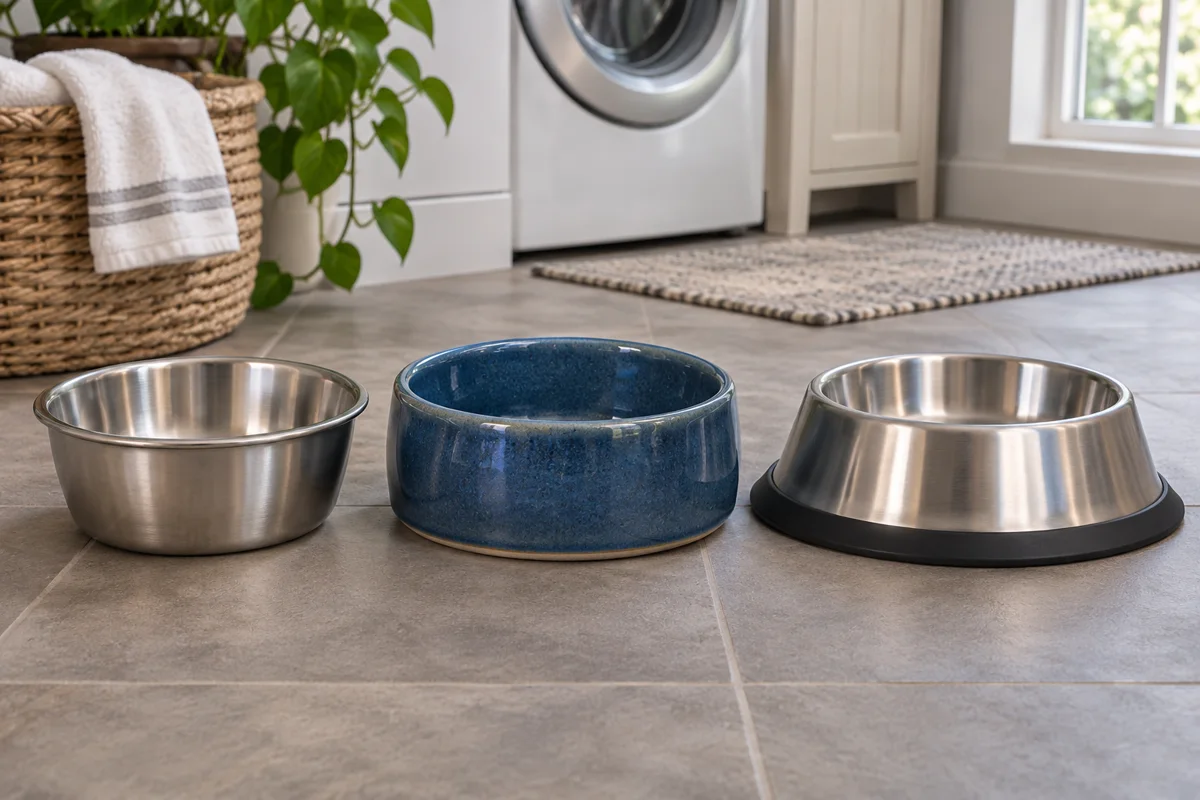
Choose a bowl that holds your dog's usual portion with room to spare, sits flat on the surface where it will be used and has an interior you can scrub all the way to the rim. Start with those three checks on the bowl you already own. If it holds the meal comfortably and cleans well, you may only need to move it to a better spot or put it on a washable mat. A bowl that looks steady when empty on a store shelf can behave differently on wet tile.
Test the food bowl and the water bowl separately. A food bowl gets pushed at the end of a meal when the dog follows crumbs around the edge. A water bowl can shift when it is almost empty or when there is a wet patch under the base. Think about where the dog stands and where you carry each bowl to refill it. Those details tell you more about what to buy than an advertised capacity by itself.
See the three bowl checks
Video summary: Check the usual portion, test the rim for sliding or rocking, and inspect underneath for grooves.
Compare dog bowl designs by the task they solve
| Bowl design | Where it can work | What to inspect before choosing one |
|---|---|---|
| Plain stainless steel bowl | A simple interior you can inspect and scrub | Whether it sits flat and whether the base slides on your floor |
| Stainless bowl with removable grip ring | A smooth floor where a plain bowl skates | Whether the ring lifts away and the channel underneath can dry |
| Heavy glazed ceramic bowl | A spot where a light bowl is easily pushed | Whether the rim and glaze are intact and the weight is manageable at the sink |
| Plastic bowl with a broad base | A lightweight bowl you carry frequently | Whether the surface is smooth, undamaged and easy to clean around the base |
| Removable bowl in a low holder | A station where two bowls need separate, fixed spots | Whether the bowl rattles and whether you can wash underneath the holder |
Materials vary from product to product. Start with the design in your hands. A broad underside, an accessible rim and a smooth, intact surface can matter more to your daily routine than a material label. For a dog with a specific feeding recommendation from a veterinarian, use that recommendation to narrow your options before comparing the everyday details.
1. Measure what goes in the bowl and what surrounds it
Put your dog's usual serving in the current bowl. Look at how far the food comes up the side and whether the dog can reach along the bottom without pushing their face against a high rim. A serving that fills the bowl to the lip will spill as soon as the dog nudges it. Food at the bottom of a deep, narrow bowl can be harder to reach than the same portion spread across a wider base. Watch a normal meal before deciding which shape suits your dog.
Measure the space the bowl uses on the floor, including any mat. Mark the outline with a sheet of paper and open nearby doors fully. Step past it with a laundry basket or groceries. When someone takes the usual route through the room, they should have room to pass without stepping around the dog or over the mat. A smaller bowl in a better corner can improve the setup more than a heavy bowl in the middle of a busy walkway.
For water, consider your actual refill routine. You want the bowl to remain accessible and easy to keep clean and filled. A deep bowl that you can barely carry to the sink without spilling may be less convenient than one you can reach and refresh easily. If several animals use the same room, check where each can approach and leave without crowding the others.
2. Test stability on the same kind of floor
Use your empty bowl first. Place it where it normally sits and press gently against one side with two fingers. Then press a little farther down, near the rim. See whether it slides, rocks, lifts at the far edge or stays flat. If you are comparing possible replacements, repeat the test on a hard surface as close to your floor as practical. The goal is to notice which movement causes the problem in the first place.
If the bowl rocks on one tile but sits flat when you slide it a few inches, look for a grout line or an uneven transition. Make sure the whole base rests on one level surface. If it stays level but skates as the dog eats, try a suitable washable mat that lies flat and grips the floor. Check it after the bowl comes away. Water underneath a mat can undo the grip you expected it to provide.
Rattling is a different problem. A loose removable bowl can tap against a frame even if the frame does not move. Seat the bowl properly and check for a gap by pushing it gently from side to side. If you have to wedge a rag under it every time, choose a pairing that fits. Avoid loose improvised pieces where a dog could chew or swallow them.
3. Inspect the parts you touch when you clean it
Turn the bowl over. Look for a hollow base, a groove around the rubber ring and seams that can hold water or crumbs. If a ring is designed to come off, see whether you can remove and replace it without stretching or digging at the edge. If it is fixed in place, check whether a cloth reaches the seam. Look at the interior, too. A sharp angle between the bottom and the wall is harder to reach than a rounded corner.
Follow the manufacturer's instructions for handwashing or dishwasher use. Check whether the bowl and the grip parts have different care requirements. If you wash by hand, try a brush that reaches the base, rim and corners without needing to scrape at them. Rinse the bowl and set it to dry so water can run out of the underside. Let the mat or holder dry as well before putting the station back together.
Replace a dish with a sharp edge or loose fragment. Look for cracked glaze, damage around the rim or a grip part that the dog can pull loose. For an unfamiliar used bowl, inspect its condition and check whether it was intended for food or water. You don't need a fancy bowl to get an easy-to-clean station. You need to be able to see and reach the parts you have to clean.
4. Use a three-meal trial before moving the station again
After choosing a bowl or changing its location, observe three ordinary meals. Note whether it stays where you put it, whether the dog can finish without pushing it into a wall, and how long it takes to clean the bowl and the patch underneath. For water, add a check later in the day to see whether the base or mat stays dry. If only one thing still causes trouble, adjust that one thing and see whether it improves.
Keep cleaning tools and replacement mats where they are easy to reach. A station that comes apart neatly in a shop should come apart as easily when you are in a hurry. If a dog sitter will use it, add the location and refill routine to the Bigodig handover sheet.
Frequently asked questions
Can I keep my current bowl if it slides?
Try it on a flat surface first, then on an appropriate, washable nonslip mat. If the bowl continues to tip, the shape or base may be the issue. If it stays put and you can clean the mat easily, you have solved the immediate problem.
Is a bigger water bowl always easier?
Choose a capacity that fits the dog's access and your refill routine. Check that it stays steady when partly empty, and that it's comfortable for you to carry and wash. Always keep fresh water available.
Should I buy matching food and water bowls?
You can choose different shapes for different jobs. Pick the food bowl for the size and shape of the meal and the water bowl for access, stability and routine refills. A matching pair is fine if both pieces pass those checks.